
Much of pharma is approaching a patent cliff right now, meaning that the blockbuster drugs of the last decade or so are about to lose their patent exclusivity. One report estimated that this patent cliff could represent a loss of $300 billion for the pharma industry by 2030. And pharma companies have become heavily financialized companies, mostly focused on seeing their stock number go up. (My colleague Matt Stoller calls this “the number go up rule.”)
Financialization and the loss of R&D
Luckily for the companies, the numbers have been going up for a few decades: many of the major pharma companies had blockbuster drugs that helped a lot of people, and they made a lot of money. Some of them focused on maintaining those patents instead of reinvesting in their R&D functions. Many of them realized that it’s actually cheaper and less risky to act as giant investment banks and choose assets to bring to development, relying on small biotech startups to take the risk of discovering new therapeutic compounds. In recent years, many of them have taken the next step and started licensing therapeutic assets from China, where clinical trials are much cheaper to conduct (a topic I am working on at length).
TL;DR: their R&D functions have atrophied, and now number about to go down.
Related articles
Eli Lilly and Novo Nordisk, though, seem to have been saved from this fate. These two companies found their next blockbuster drugs in GLP-1s…only to be confronted with another series of problems. They’re facing down compounders and a lot of bad press for high drug prices. The easy availability of certain drugs online, especially during the pandemic, seems to have primed the general population to expect to be able to access prescription drugs through telehealth and at accessible cash prices.
In response, Lilly and Novo Nordisk decided to open their own consumer portals.
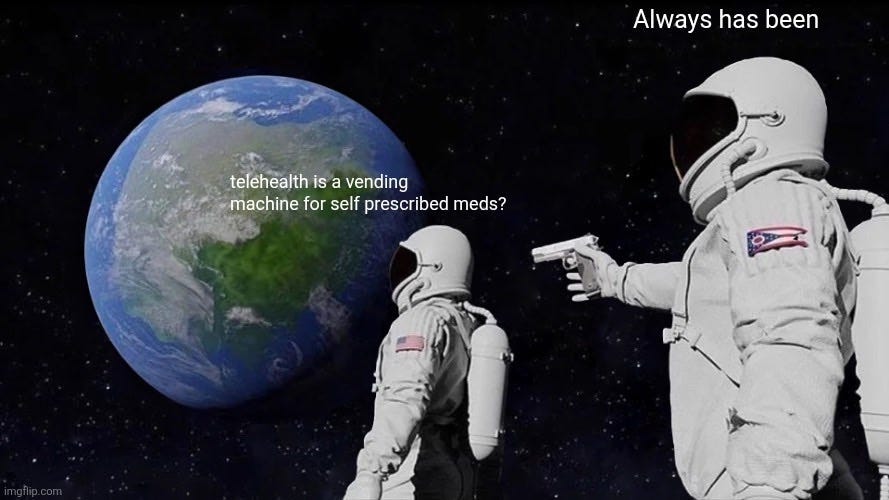
Telehealth as a vending machine
These portals — called LillyDirect and NovoCare — offer drugs at a discount, and they link out to recommended telehealth and in-person providers. Although the providers are independent, it seems likely that if you sign up, you’re going to get a prescription. Not only that, but it also seems likely that the providers will prescribe the referring manufacturer’s specific drug.
There are several different formulations of GLP-1 medications, and in a typical care setting, a physician is likely to try to triangulate your particular condition and medical history with your insurance formulary to choose the right medication. In this setting, it seems likely that the physician is going to default to the best drug offered by the referring manufacturer. I’m not trying to impugn the physicians associated with the telehealth services promoted by Lilly and Novo…but even independent physicians are influenced by financial ties with pharmaceutical companies.
The power of a subscription
Eli Lilly and Novo Nordisk are contending with another issue, too: the patient non-adherence rate for GLP-1s is very high (a study from 2024 found that only 32% of patients remained on a GLP-1 at the 1 year mark). Some people might purposely cycle on and off, at the recommendation of their wellness doctor or a Reddit thread. But many experience untenable side effects or find they can’t afford the prescription long-term.
In a situation where a patient is using this drug to manage uncontrolled diabetes or another condition, and where they are presumably being seen by a traditional endocrinologist, these side effects can be managed with additional drugs and a ramp-up schedule with the medication. But in a telehealth setting, many people are left to deal with the side effects — and many do, by stopping the drug. That’s bad for Eli Lilly and Novo Nordisk, who want everyone possible on their GLP-1s.
At the same time, the two corporations have been battling for market share, especially for their oral GLP-1s. Novo Nordisk undercut Eli Lilly’s prices when Novo launched its oral Wegovy, and Lilly just responded with its latest tactic: lowering its price for patients who continually renew their prescription. (You just know a McKinsey consultant somewhere is gleeful over that one.)

The catch: if your prescription isn’t renewed in a timely fashion, your price reverts to the higher cash pay price. For the 14.5mg dose of Lilly’s Foundayo, that’s a difference of $50 as of this writing ($299/month with refills within 45 days, or $349 without the discount). Novo Nordisk’s Wegovy pill is also $299/month.
Of course, that’s not a huge difference if you’re already willing to pay nearly $300 a month for these medications, but there’s something that feels off to me about monthly discounts for medications. (Maybe pharmaceuticals shouldn’t be wholly commoditized and direct-to-consumer! Maybe we should’ve learned lessons about how aggressive marketing can result in patient harm!)
Also, it’s neither here nor there but STAT News noted in its coverage of the speedy FDA approval of Foundayo that Lilly received approval as part of its commitment with TrumpRx to offer some of its GLP-1s at reduced prices — and indeed, Foundayo is currently available on the TrumpRx website, which links out to LillyDirect. (Reuters, meanwhile, reported that Lilly executives were pushing the FDA to move even faster.)
It’s all totally chill! Come get your subscription drugs!